
Building a 3,000-capacity worker camp in Saudi Arabia within five months or setting up a fully operational medical clinic in the Brazilian Amazon in six weeks what does one need? The answer, more and more, points to modular container construction. ZN House, a company that has carried out more than 2,000 container building projects around the world on all six continents and in over 50 countries, has demonstrated, through its experience, that modular methods can beat traditional construction in speed, cost, sustainability, and resilience.
Here we break down what ZN House's worldwide project portfolio indicates about the direction of prefab container construction in 2026 and what any procurement officer, developer, or government agency should be aware of before deciding on their next modular building project.
Why the Global Demand for Modular Container Projects Is Accelerating
Traditional construction is slow, wasteful and prone to errors due to environmental conditions. Modular container construction is an innovative solution that can eliminate those drawbacks. More than 80% of construction components are produced privately in the factory. Besides, factory-controlled assembly not only reduces the impact of the weather on the work, but also greatly reduces losses of materials and labor bottlenecks.
Owners of projects located in remote or challenging areas - such as mining operations in the Australian outback, infrastructure camps in Alpine Serbia, or disaster relief zones in Oceania after a cyclone - will find the benefits quite convincing. Rapid deployment might well be the difference between maintaining operations or succumbing to project failure. This trend is also evident in the global modular construction market. Most of all, the demand spots are the Middle East, Africa, and the resource-extraction industries in the Asia-Pacific region. With 17 years of experience in various geographical locations and project types, ZN House stands as one of the most experienced modular container building companies globally.
ZN House Global Container Project Portfolio: Region-by-Region Breakdown
The following is a summary of the major regional project clusters for ZN House based on key data points:
|
Region |
Featured Projects |
Key Challenge Solved |
Build Speed |
Capacity / Scale |
|---|---|---|---|---|
|
Asia |
Philippines typhoon-resistant homes; Indonesia pandemic clinic |
Coastal flooding, rapid medical response |
60% faster on-site |
72 homes; 15-day clinic |
|
Africa |
South Africa mining village; mobile school sanitation units |
Remote logistics, cost reduction |
Weeks vs. months |
100-person camp; 70% long-term cost savings |
|
Europe |
France Passivhaus school dorm; Berlin KfW-55 office |
Green compliance, zero-waste mandates |
10-month campus |
100-student complex; 5% construction waste |
|
North America |
Arctic Canada mining cabins; Mexico mobile border clinics |
Extreme cold, infrastructure-free sites |
8–10 weeks |
50 cabins; zero civil works |
|
South America |
Brazilian Amazon solar clinic; São Paulo seismic apartments |
95% humidity, seismic risk |
6 weeks (clinic) |
100 apartments; 80% less waste |
|
Oceania |
Australia outback mining camp; NZ seismic school classrooms |
Bushfire, cyclone, seismic risk |
10 weeks; term-break install |
72-hour relief deployment; the source's '7.0M quake-rated' claim is not a valid building seismic-performance classification. |
Table 1: ZN House container project data by region. Build speed comparisons are relative to equivalent conventional construction timelines.
Asia: Typhoon-Proof Speed and Pandemic Readiness
In the Philippines, ZN House constructed 72 modular homes stacked on top of each other for a village by the sea, using flood-proof foundations, reducing on-site construction time by 60% compared to traditional methods. On the dormitory project of a rural school in India, despite limited use of the site, 10 solar-cooled classrooms were set up within eight weeks. But the most shocking is that, in reality, a container clinic which is equipped with negative-pressure medical units and designed for pandemic readiness in Indonesia was put into operation in just 15 days from the moment of its delivery.
Africa: Radical Affordability and Relocatable Design
The mining sector in South Africa has been using container construction for setting up worksite villages at remote locations for a long time. A large dormitory for 100 people and an office complex made by ZN House were made at around half the price of a similar brick building. In the projects of schools in rural Africa, sanitation units that are self-contained with water-recycling toilets in steel enclosures that are corrosion-resistant have stopped the use of pit latrines and lowered the cost of the operation over time by up to 70%.
Europe: Green Certification and Circular Design
The source reports a French dormitory for 100 students completed in 10 months with 40% lower heating costs, calling its insulation Passivhaus-equivalent; UK retail construction waste at 5% of material input; and a Berlin office at KfW-55. It supplies no certificates or calculations. Insulation, solar façades and prefabricated services alone cannot establish whole-building energy performance.
North America: Extreme-Cold Engineering and Urban Flexibility
The source reports 50 aerogel-insulated Canadian Arctic units delivered in less than 10 weeks, but gives 45°C here and −45°C later. This sign conflict and the claim of no auxiliary heating require thermal calculations and project records. The Mexican mobile-clinic claim of no groundworks also requires confirmation of site support, anchorage and permit conditions.
South America: Seismic Resilience and Off-Grid Operation
The source claims a São Paulo scheme for 100 families resists earthquakes 'up to 9 degrees' and produces 80% less waste. No seismic scale or design conditions are supplied, so this is not a usable seismic-performance rating. It also describes helicopter-delivered classroom and dormitory modules in the Colombian Andes; rainy-season operation requires confirmation of the solar and storage system.
Oceania: Cyclone, Bushfire, and Seismic Performance
The source describes Australian camps deployed over 10 weeks in 45°C summer heat with reflective roofs and solar-diesel power; these features alone do not establish bushfire safety. It describes New Zealand classrooms with seismic isolation, rain-noise control and term-break installation, but 'approval for magnitude 7.0' is not a valid building performance classification. Check site actions, structural design and approval documents.
Four Flagship Container Projects That Define ZN House's Capabilities
Four of ZN House’s most referenced delivered projects are examples of the upper boundary of what modular container construction can achieve at scale:
|
Project |
Year |
Capacity |
Delivery Time |
Standout Feature |
|---|---|---|---|---|
|
Saudi Base Labor Camp |
2023 |
2,000 workers |
5 months |
Heat-reflective nano-coatings + IoT utilities |
|
Qatar FIFA 2022 Fan Village |
2022 |
1,000+ units |
Pre-event |
Post-event repurposed as disaster relief shelters |
|
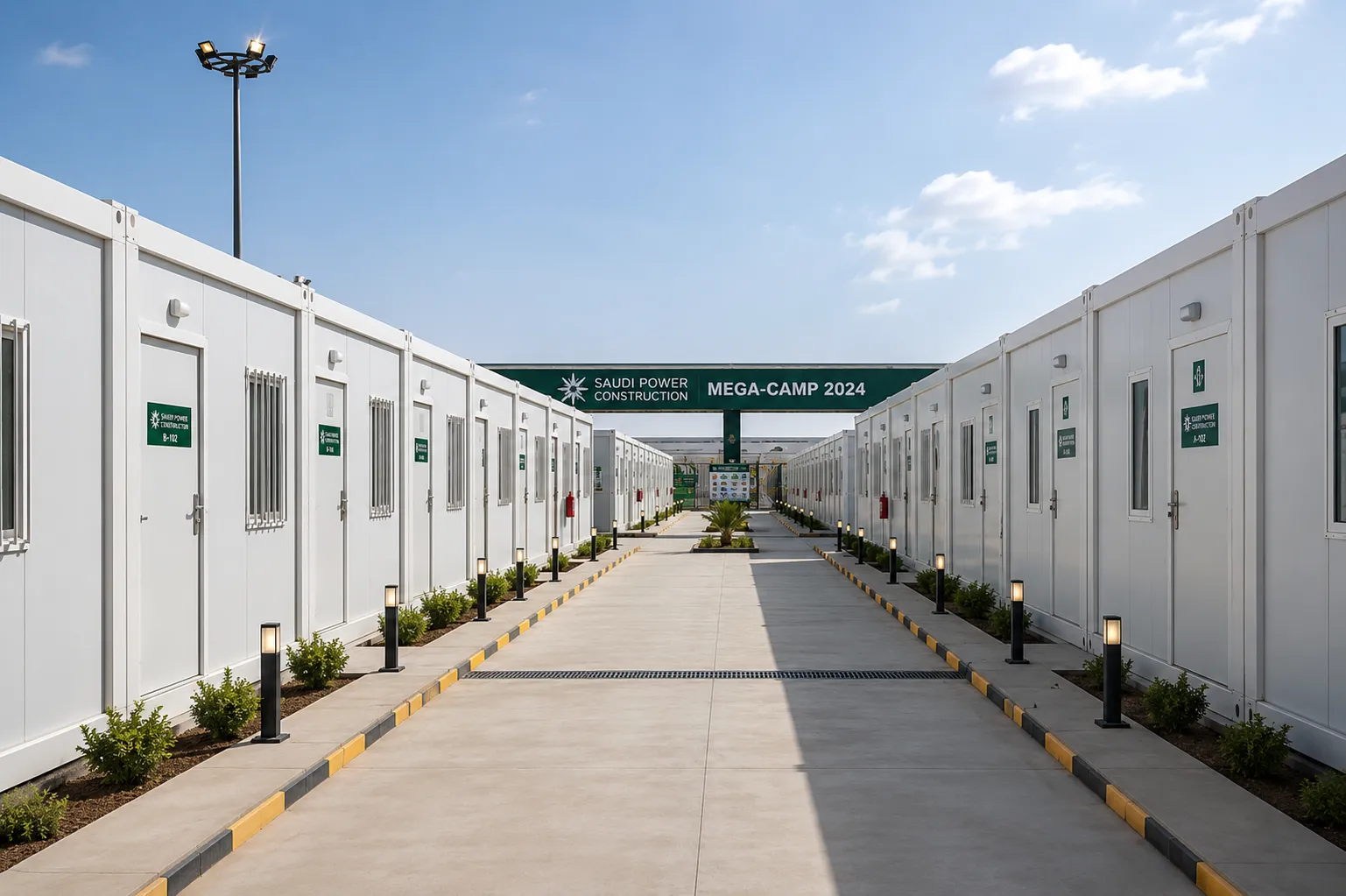
Saudi Power Mega-Camp |
2024 |
3,000 workers |
On schedule |
Solar microgrids + AI climate control |
|
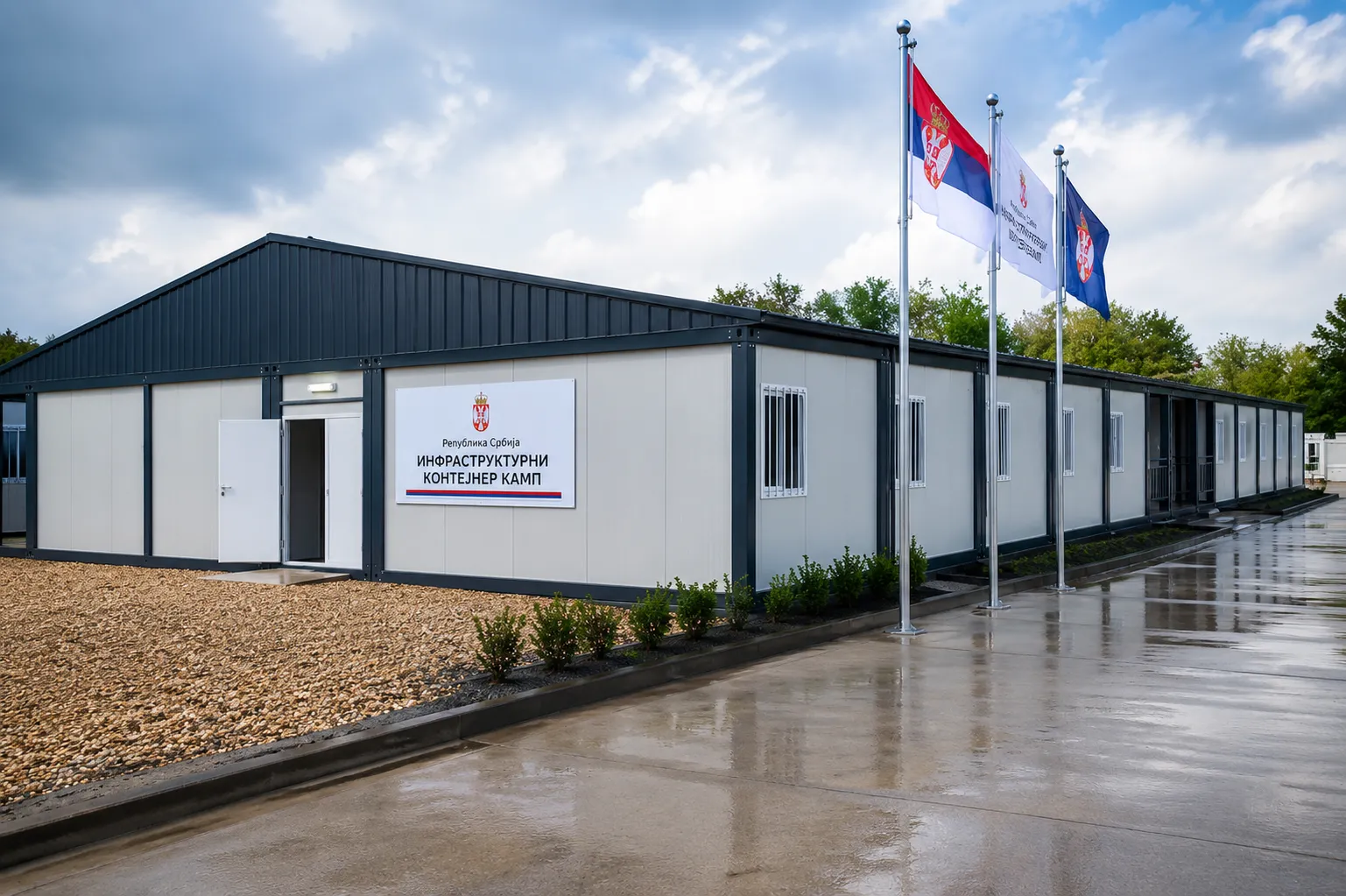
Serbia Infrastructure Camp |
2024 |
800 workers |
On schedule |
Alpine thermal insulation + storm-resistant frames |
Table 2: Selected flagship ZN House container building projects, 2022–2024.
The Qatar FIFA 2022 Fan Village, in fact, offers a good example: Having served over 1,000 visitors during the championship, these modular structures were taken apart and turned into shelters for earthquake victims-a clear illustration of the circular economy idea implemented at the level of infrastructure, which traditional construction could never match.
The Precision Manufacturing Advantage: Why 80% Off-Site Fabrication Changes Everything
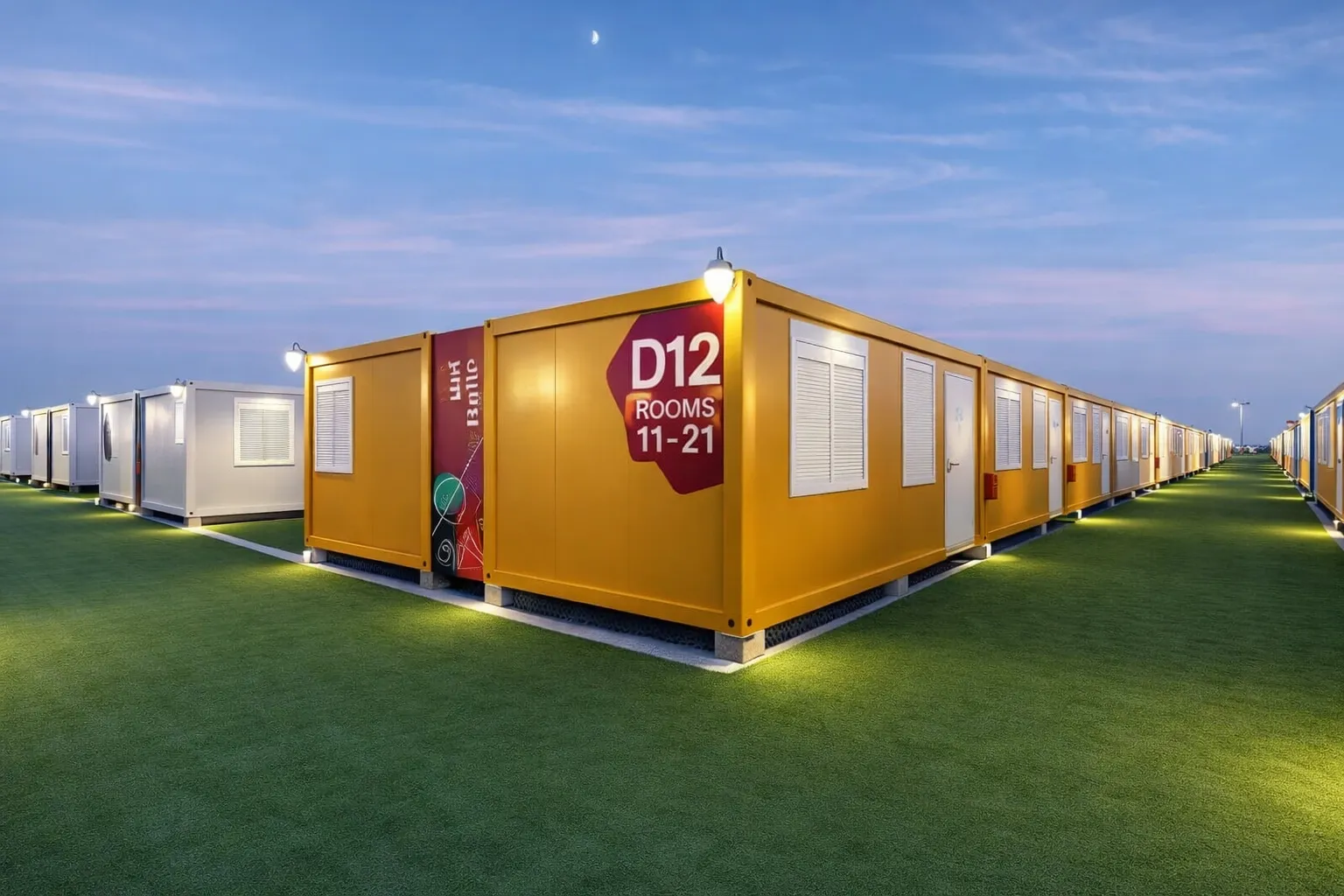
The main feature that identifies ZN House's building method is the amount of prefabricated work done in the factory versus the site. By having more than 80% of parts being manufactured before delivery, the consequences affect all facets of project implementation:
- Some welding and preliminary wiring can occur in the factory, but heavy lifting, structural connections and electrical work may remain on site and require appropriate controls.
- Quality consistency is verifiable at each production stage, eliminating the variation introduced by rotating site crews and variable weather conditions.
- Labor requirements on-site shrink by approximately 60%, making remote sites more economically viable.
- Environmental impact is minimized: factory prefabrication produces near-zero on-site waste, eliminates debris, and reduces noise pollution for surrounding communities.
- Modules arrive pre-wired, pre-plumbed, and pre-finished, reducing on-site assembly to connection and commissioning rather than construction.
In particular, this method can be very helpful with school dormitory projects, since conventional methods of construction would necessitate a long stay on site that would interfere with the school's operations. Modular classrooms and dormitories that are crane-installed, as done by the ZN House, are usually set up during school holidays, and students come back to their classes in fully furnished rooms after only one break period.
Real-World Case Study: Post-Hurricane Emergency Housing, Caribbean Region
After a Category 4 hurricane devastated a coastal community in the Caribbean, the local emergency management team asked for 200 transitional housing units to be provided in three weeks a deadline impossible to meet by any conventional construction method.
ZN House's rapid-response container house project brought an innovative solution by delivering pre-manufactured residential modules with factory-installed plumbing, electrical systems, and interior fit-out. The units were transported through sea freight, and a 40-crew team assembled them in 19 days. No on-site welding was required, and zero structural defects were registered in the whole 200-unit installation.
The project, apart from the figures, embodied a principle that ZN House has now validated through numerous disaster-response deployments: modular container building is not a floor compromise solution for emergencies. In fact, modular housing can be better performing than conventional construction in many aspects, and the difference in speed between factory prefabrication and site construction is most significant right when the need is most urgent.
ZN House keeps working alongside government emergency preparedness programs in the Asia-Pacific and Caribbean regions with modular housing inventories always ready to be quickly supplied.
ZN House Container Project Solutions: Application Range
These solution types are the main areas where ZN House actively delivers projects. All these solutions are based on the same manufacturing platform at the core, but with application-specific engineering added to each one:
- Container commercial buildings (retail parks, pop-up villages, multi-story mixed-use)
- Remote worker camps and mining camps (off-grid, corrosion-resistant, scalable to 3,000+ persons)
- Modular medical facilities (container hospitals, mobile clinics, biocontainment units)
- Educational campuses (container classrooms, school dormitories, canteen facilities)
- Container offices (LEED-optimized, smart-building integrated, relocatable)
- Industrial warehouses (clear-span, heavy-load-rated, climate-controlled)
- Adaptive reuse and container transformation projects
- Disaster relief and refugee camp infrastructure
For every category, there are reference projects with verified performance data that have been completed on multiple continents. This is supporting evidence for prospective clients, who are, because of this, not relying on claims by manufacturers only.
Industry Context: Modular Construction Market Trends
The global modular construction market is expected to see major growth over the next several years. This growth is largely due to a persistent shortage of skilled construction workers, stricter environmental regulations in Europe and North America, and urgent infrastructure needs in the Middle East and Africa. McKinsey & Company highlights modular and off-site building as key strategies to curb overruns in costs and project timelines in their analysis of the construction productivity gap.
ZN House's portfolio targets the top growth categories in the modular market based on forecasts: housing for workers, schools, and emergency or temporary shelters. With operations across 50 countries and 17 years in business, ZN House stands tall among a few manufacturers that have the size and proven capability to confidently meet big procurement projects in these areas.
Frequently Asked Questions: ZN House Container Building Projects
|
Question |
Answer |
|---|---|
|
How fast can a modular container camp project be deployed? |
Most ZN House container camp projects are fully operational 70% faster than equivalent traditional construction. Small-to-medium camps (up to 200 units) typically achieve occupancy within 8–12 weeks from factory dispatch. |
|
Can prefab container buildings meet European green certification standards? |
Prefabrication can support a project designed to the applicable standard, but it does not automatically obtain certification. The source provides no evidence for the Passivhaus-equivalent or KfW-55 claims; insulation, solar façades and prefabricated services alone do not establish whole-building performance, and 'non-toxic' materials require specific evidence. |
|
Are container house projects suitable for extreme climates — both hot and cold? |
Suitability requires site-specific design. The source lists aerogel insulation for −45°C Canada, reflective coatings in Saudi Arabia, tropical corrosion protection in the Amazon and screw-anchor foundations in Oceania, but its earlier Canadian figure is 45°C. Confirm that conflict and the actual design; these features do not establish universal suitability. |
Conclusion: What 2,000+ Completed Projects Prove
Modular container construction is no longer just a hypothesis. ZN House has done over 2,000 projects in 50+ countries that show prefab container building could meet - and in many cases exceed - the standards for conventional construction on speed, structural resilience, environmental compliance, and lifecycle cost.
People involved in procurement, developers and government agencies who are considering modular options for their next project will most likely find the conversation with a manufacturer to be a good starting point since that manufacturer's reference projects are a good match with the specific geography, use case, and environmental conditions at play. ZN House's regional project data - from Arctic mining camps to tropical disaster-relief hospitals to European-grade school campuses - gives that baseline.
Find out more about ZN House's extensive global project portfolio at zn-house.com/us/project.html, or reach out to the team directly to talk about your project needs.
Watch ZN House Projects in Action
Watch how the ZN House manufacturing process enables them to carry out container building projects globally, from the factory floor to the final installation stage!! Subscribe to the ZN House channel on YouTube to view project walkthroughs, time-lapse builds, and client testimonials: youtube.com/@ZN-HOUSE
Related ZN House Resources:
- Mining Camp Container Solutions → zn-house.com/us/mining-camp.html
- Construction Camp Container Buildings → zn-house.com/us/construction-camp.html
- Container Hospital & Modular Medical Clinics → zn-house.com/us/container-hospital.html
- Container Schools & School Dormitories → zn-house.com/us/container-schools.html
- Flat Pack Container Houses → zn-house.com/us/flat-pack-container.html