
Consumer preferences for environmentally friendly and budget-friendly living have increased considerably over the past several years. Among the outstandingly distinctive alternatives which have attracted a lot of attention from the construction and prefabricated mobile housing industry are T-type houses and container houses. Both these innovative housing platforms have attractive merits such as low cost, recyclability and being adaptable to different weather conditions. Nevertheless, which one is the better option for your working plan still remains unanswered. This article is a comparison of T-type houses and container houses, identifying their characteristics, advantages, and differences that support the decision-making process.
I have been the Project Manager at ZN House for the last 5 years, during which I have deeply engaged in various prefabricated housing solutions such as T-Type houses and container houses having personally overseen the installation and deployment of over 50 T-Type houses and 100 container units. This article represents my knowledge and industrial presence, and it aims to provide an understanding of the on-the-ground and technical side of these two housing options.
What is a T-Type House?
The source cites The House Designers for a T-shaped floor plan made from two perpendicular sections. This is a description of plan geometry, not a universal definition of every product sold as a T-Type prefab house.
The T-Type home is a contemporary, prefabricated living alternative aimed to provide utmost comfort and long-lastingness in severe weather conditions. Such dwellings employ environmentally-friendly materials that enable the housing unit to be well insulated, thus making the structure appropriate for localities where the weather is severely cold, or it is windy or hot. The T-type residence is a single-panel design that can be customized in terms of square footage, floor plan, and features as per the clients' requirements.
Key Features of T-Type Houses
Energy Efficiency: Proper insulation of walls and roofs is the main factor in T-Type houses that guarantees the consumption of energy to be kept at a low level.
Sustainability: The T-Type houses, made from environmentally friendly materials, are a great choice for a lifestyle that is not connected to the grid.
Weather resilience: With the ability to withstand harsh weather conditions, T-Type houses can be used in either cold or hot regions.
|
Feature |
T-Type House |
|---|---|
|
Insulation Quality |
Superior, R-value ≥ R-25 (Walls/Roof), suitable for extreme climates |
|
Customization |
Flexible design, layout, and modular sizing (e.g., from 300 to 2,500 sq ft) |
|
Energy Efficiency |
Optimized for IECC standards, low consumption (due to high R-value) |
|
Durability |
High, engineered to withstand high wind loads (up to 120 mph) and harsh conditions |
Table 1: Key Features of T-Type House
To read about the growing popularity of T-Type house from another article (from our blog), click here.
What is a Container House?
The source refers to Orchard when distinguishing container homes from the specific U.S. manufactured-home category. Local building approvals still apply. Its claim of meeting IECC Zone 4 R-value requirements gives no code edition, assembly or calculation and does not establish compliance.
One of the most talked-about alternatives to regular buildings is container houses. With the help of this creative idea, one can transform an old container into a cozy place to live. Because these houses are sturdy, expandable, and low-priced, they have become a great option for the whole socioeconomic spectrum of housing projects. Container houses would be perfect for those who need affordable housing in the city or in the countryside.
Key Features of Container House
Affordability: Container homes are usually more cost-effective in comparison to conventional ones because they are built out of recycled shipping containers.
Flexibility: As with T-Type structures, one can design a container house in any way to fit the individual requirements of various customers.
Sustainability: The re-purposing of discarded shipping containers is a step towards less pollution and a smaller carbon footprint.
|
Feature |
Container House |
|---|---|
|
Cost |
Generally, more economical due to repurposed materials |
|
Flexibility |
Highly customizable, scalable by stacking or joining standard ISO container units (8’ x 20’ or 8’ x 40’) |
|
Sustainability |
High, due to the reuse of standard Corten steel shipping containers |
|
Durability |
Inherently strong, requires structural reinforcement for major modifications |
Table 2: Key Features of Container House
Key Differences Between T-Type Houses and Container Houses
According to a report by Fortune Business Insights, the global container homes market was valued at USD 61.83 billion in 2023 and is projected to reach USD 108.70 billion by 2032, demonstrating a Compound Annual Growth Rate (CAGR) of 6.7% over the forecast period (Fortune Business Insights, 2025).
Comparing T-Type houses with container houses cannot be done without taking into account several factors. Modular housing solutions are offered by both means, but their designs, the materials used, their energy efficiency, as well as their suitability for different climates and projects vary.
Design and Construction
- T-Type: T-Type houses are designed based on prefabricated modular layouts which are in most cases customized according to specific needs, for instance, if the house is required to be highly insulated or if it should have some additional features like solar panels.
- Container: Container houses are constructed from old shipping containers that have been recycled, so they basically have a stronger type of construction that, in the majority of the cases, has to be changed for insulation and reinforcement of the structure.
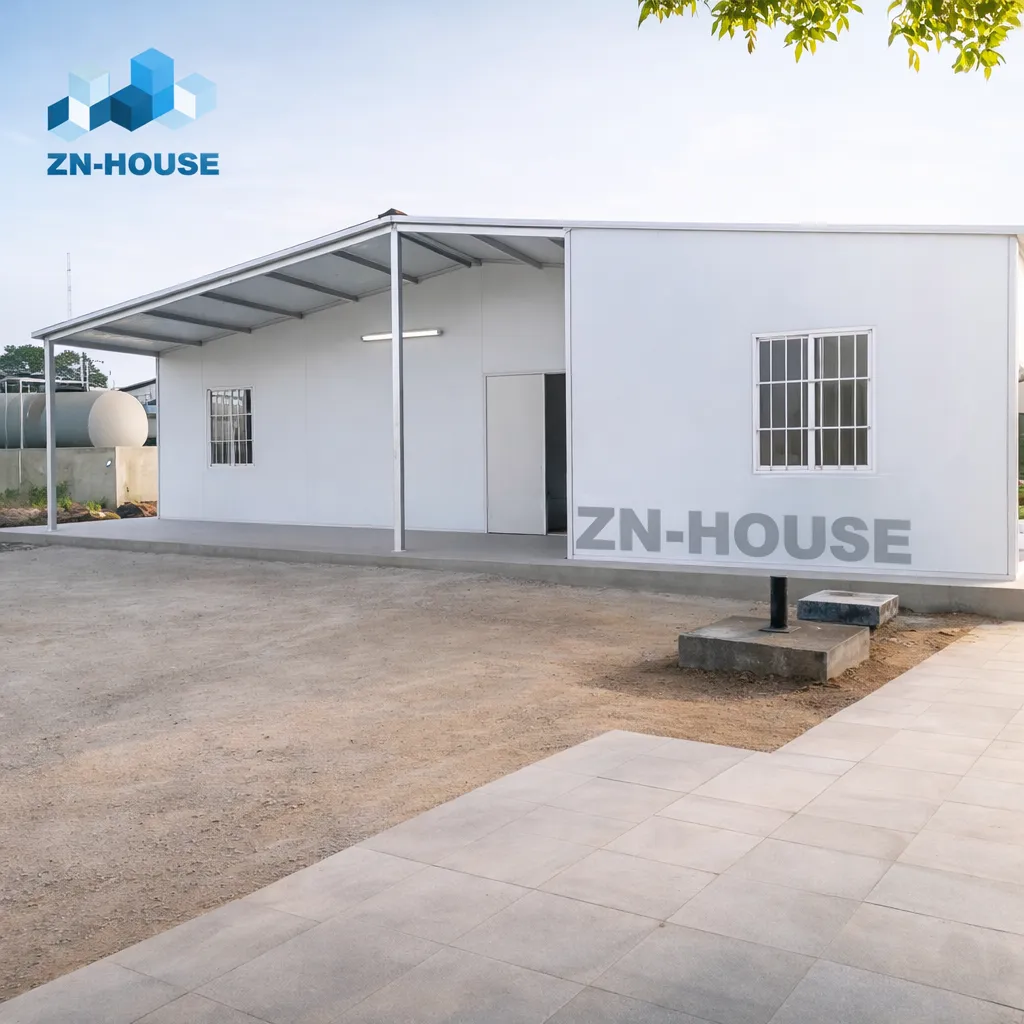
Fig. 1: A T-type House
Energy Efficiency and Insulation
- T-Type: T-Type homes are typically more energy-efficient due to the superior insulation they are equipped with. In fact, these houses are designed for extreme cold or hot conditions, often achieving wall R-values of R-25 or greater, making them ideal for energy-conscious people living in such climates.
- Container: Corten steel alone does not provide the required building insulation. The source’s R-3 to R-13 range has no identified assembly and must not be treated as a universal bare-container R-value. Insulation upgrades need to address thermal bridges, moisture and fire requirements.
Cost-effectiveness
- T-Type: T-Type houses typically cost more but provide more personalization and ecological sustainability in the long run for people who are ready to make a more substantial and energy-efficient
- Container: Container homes are generally more affordable as they are made from recycled shipping containers. They are an ideal option for those who have a tight budget or require a quick and temporary solution.
|
Factor |
T-Type House |
Container House |
|---|---|---|
|
Design |
Modular, customizable panel construction (T-shaped base layout) |
Rigid structure, repurposed ISO shipping container dimensions |
|
Energy Efficiency |
High (R-25+ installed insulation), ideal for thermal performance |
Source states R-3 to R-13; assembly not identified, not a bare-container performance rating |
|
Speed of Construction |
Fast (prefabricated panels) |
Fast (unit delivery and placement) |
|
Lifespan |
50+ years (engineered residential structure) |
25-30 years (depending on refurbishment and ongoing maintenance) |
Table 3: Main Differences: T-Type vs Container House
The T-Type Solution: For a fixed site housing 500 people for 5 years, compare upfront capital expenditure (CAPEX) together with foundations, services and maintenance. Material price alone cannot establish the lowest-cost option.
The Container Solution: For a project moving every 6 months, include dismantling, transport and repair in operational expenditure (OPEX) and total cost of ownership (TCO) before selecting a system.
Which is Better for Your Project?
Choosing between a T-Type house and a container house depends on your specific project needs. Here are some considerations:
For Locations with Very Harsh Weather Conditions: In case your construction is at a place having either extreme temperatures or severe weather, T-Type houses provide better insulation and resistance. Such dwellings are made especially for difficult surroundings and are just right for living in them for a long time.
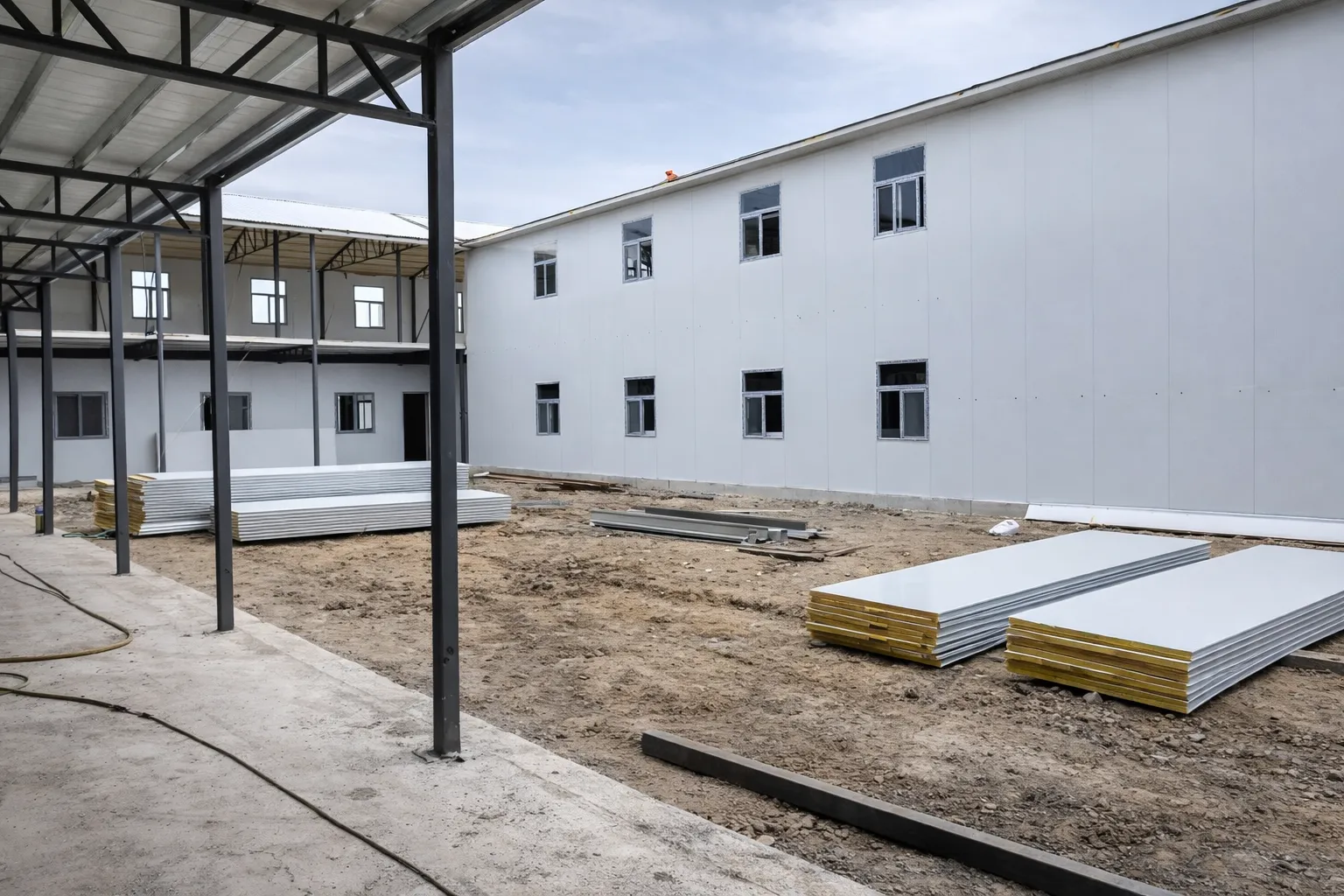
Fig. 2: A T-type Housing Project
For A Low-Cost, Short-Lived Type of Housing: In case money is the main factor, container houses will be cost cost-effective, scalable way to solve your problem. They are just right for short-term projects or as a temporary housing solution.
For the Use of a Modular Lifestyle: Both T-Type houses and container houses are basically the same in that they are modular, which means the design and usage can be changed. Nevertheless, T-Type houses may give you more chances to be able to customize because they are a modern prefabricated design.
Choosing between a T-Type house and a container house mainly depends on the different advantages that each of these alternatives offers you. T-Type houses, being more eco-friendly, energy-efficient, and durable, while container houses are cost-effective and more flexible. It would be a good idea to consider the weather of your project, your budget, and your future before making a decision.
Real-life Examples
Case Study 1: Choosing T-Type House for the Coastal Region in Australia
Time: 2023
Location: Queensland, Australia
Situation: A Queensland coastal development project needed worker housing that could be placed in an environment characterized by strong winds, humidity, and seasonal storms. The project called for sustainable housing able to endure severe coastal weather and still meet energy efficiency requirements. The primary technical challenge was the low soil-bearing capacity of the coastal sand dunes, requiring a lightweight yet resilient foundation.
Solution: The source describes T-Type units with shallow helical piles for an approximately 75 kPa ground-bearing condition, intended to reduce excavation. No ground investigation, pile design or calculation is supplied; this is not a foundation solution that can be transferred directly to other coastal sites.
Testimonial:
“T-Type House is a solid solution for our shore project. Its heavy-duty features and resistance to wind and humid air helped stabilize and make comfortable the workers' living quarters, and they were even able to enjoy the storm inside. ZN House made a quality product available to us.”
- Jessica Williams, Project Manager, Queensland Coastal Development Authority
Case Study 2: Choosing a Container House for Temporary Housing in Dubai
Time: 2022
Location: Dubai, UAE
Situation: A construction company in Dubai needed temporary accommodation for a big workforce that was the skyscraper project. Quick setup and portability were the main priorities, but the solution had to combat the extreme summer heat (often exceeding 45 degree Celsius).
SolutionThe source describes 50 mm closed-cell polyurethane foam to walls and ceilings, plus an exterior ventilated rainscreen, and reports approximately R-19 to support HVAC operation. No complete assembly or calculation is supplied; 50 mm thickness alone does not establish the whole-building R-value.
Testimonial:
“Container houses were a great, economical way to solve the problem of housing our big workforce. Fast installation and the adaptability of the containers were the main reasons we could keep to our project timelines and still reduce costs. ZN House was the one who did it very well.”
- Ahmed Khan, Site Manager, Dubai HiTech Construction Project
Conclusion
To sum up, the decision to go for T-Type houses or container houses is basically influenced by the necessity of your work. Whichever you are aiming at, an affordable solution or a super durable, energy-saving home, both are good choices to make. In case you want a durable, tailor-made house for harsh weather conditions, T-type houses will serve you better. On the other hand, if your goal is to have a cost-effective, temporary, or modular living solution, then container houses may be the right choice.
Searching for the ideal housing solution for your project?
Here at ZN House, we focus on offering flexible, eco-friendly, and green living solutions, such as T-Type houses and container houses, which are designed to fit your exact requirements.
Request Your Free Quote Now! ((No obligation, we respect your privacy.)
FAQS
What are the key differences between T-Type houses and container houses?
Answer: T-Type houses provide more insulation and are energy-efficient, which is perfect for very cold or hot climates. On the other hand, container houses are less costly; however, they may require some additional work to be properly insulated.
Are T-Type houses more expensive than container houses?
Answer: The source’s statement here that T-Type homes are usually no more expensive conflicts with its earlier claim that they typically cost more. Compare quotations for the same area, use, specification and scope of delivery.
Can T-Type houses be customized for different climate conditions?
Answer: Yes, T-Type houses are highly customizable and designed for various extreme climates, offering superior insulation and durability.
Disclaimer:
The details shared through this article are purely for information purposes only. ZN House does not guarantee the accuracy or the completeness of the content. It is highly recommended for the readers to seek the advice of experienced professionals in the industry and also do their own research before arriving at any decision based on this information. Any decisions made based on this article are entirely at the risk of the user.